This standardized comparison table maps coverage eligibility differences between tenant improvements and base building insurance policies, to support consistent commercial property claim file organization for property managers, tenants, and claim adjusters. It eliminates common misclassification errors that delay claim resolution by aligning policy terms, lease requirements, and damage documentation in a single reference format. This resource is for educational folder processing use only, and does not constitute coverage advice, nor bind any insurance carrier to a claim determination; all eligibility questions should be directed to your licensed insurance broker or policy issuer.
Table Column Labeling for Covered Improvement Categories
Each column label is standardized to match language used in most commercial building insurance policies and commercial lease agreements, so you can cross-reference documents directly without translating jargon between stakeholders. The table below outlines each label, its associated covered party, eligible perils, required documentation, and lease alignment check to add to your claim file. You can print a copy of this table to add to your claim file’s coverage eligibility divider, to quickly reference when sorting damage estimates and policy documents.
| Column Label Name | Covered Party | Eligible Peril Scope | Documentation Required for Claim | Lease Alignment Checkbox |
|---|---|---|---|---|
| Base Building Structural Components | Property Owner / Building Policy Holder | All named perils on base building policy (fire, wind, hail, structural failure from covered events) | Original building as-built drawings, pre-lease condition inspection report | ☐ Lease confirms landlord retains full ownership of structural elements |
| Permanent Building Fixtures (Landlord Installed) | Property Owner / Building Policy Holder | All named perils on base building policy, excluding damage from tenant negligence | Pre-lease fixture inventory, maintenance records for fixtures | ☐ Lease specifies listed fixtures are landlord property and not modified by tenant |
| Tenant Installed Permanent Improvements | Tenant or Landlord, per lease terms | Covered only if TI endorsement is active on either building or tenant policy, excludes unapproved modifications | Written landlord approval for TI work, construction permits, installation receipts | ☐ Lease specifies which party is responsible for insuring permanent tenant improvements |
| Tenant Removable Trade Fixtures | Tenant | Covered only under tenant’s commercial personal property policy, excluded from base building coverage | Proof of fixture ownership, installation records showing non-permanent mounting | ☐ Lease confirms tenant retains right to remove trade fixtures at lease end |
| Temporary Tenant Site Modifications | Tenant | Excluded from all permanent property coverage, covered only under tenant’s general liability or short-term policy | Work order for temporary modification, proof of liability coverage | ☐ Lease explicitly permits temporary modifications for tenant operations |
Row Header Box Entries for Core Building Coverage Exclusions
These row headers are pre-printed in the exclusions section of the vast majority of standard commercial building insurance policies, so you can cross-reference each damaged asset against these entries to eliminate ineligible claims before submission to the carrier. The core entries to mark in your file’s exclusion tracking box are: first, structural damage caused by unapproved tenant modifications: any structural alteration not approved in writing by the property owner prior to installation is excluded from base building coverage, even if the modification is permanent and would otherwise be covered. Second, permanent alterations not listed on the base building coverage schedule: if the property owner did not update their building coverage schedule to include new permanent improvements installed after the policy start date, those improvements are not covered under the base policy. Third, tenant-owned trade fixtures, regardless of installation method: all fixtures that the tenant is permitted to remove at the end of the lease are explicitly excluded from base building coverage, even if they are mounted to walls or floors for the duration of the lease. Fourth, temporary modifications intended for removal before lease expiration: pop-up walls, temporary flooring, and other short-term modifications are not considered permanent building components, so they are excluded from all property coverage under the building policy. You should mark any of these exclusions that apply to your claim on the front of your file folder, to ensure the adjuster addresses eligibility early in the process.
Coverage Limit Schedule Fields for Peril Eligibility Matching
These fields are located on the declarations page of both building insurance policies and tenant improvement endorsement forms, and you should pull copies of these fields into your claim file’s coverage summary tab to match against the damage value and type. The required fields to log are: aggregate base building coverage limit, optional tenant improvement endorsement limit (if added to either the building or tenant policy), named peril exclusions specific to tenant improvement work, vacancy clause applicability threshold, and loss of use allocation percentage for tenant-facing damage. Illustrative example: if your building policy has a $2M aggregate limit, and a separate TI endorsement limit of $300,000, damage to tenant-installed custom reception desks that are classified as permanent improvements would be applied to the $300,000 limit, not the $2M base building limit. If the damage amount exceeds the TI endorsement limit, you will need to reference the lease to determine which party is responsible for the remaining cost. Always confirm the accuracy of these limit fields directly with your policy issuer, as policy endorsements can be updated mid-term without automatic notification to all lease stakeholders.
Qualifying Improvement Note Annotations for Lease Requirement Alignment
These annotations go in the notes section of your claim file, to tie coverage eligibility directly to written lease terms, which are required evidence for all commercial property claim determinations. The required annotations to add before submitting a claim are: a copy of the written landlord approval for all tenant improvement work completed at the property, a highlighted copy of the lease clause specifying which party holds ownership and insurance responsibility for each type of improvement, a copy of all local building permits issued for tenant improvement work, and proof that the tenant has maintained active coverage for tenant improvements or trade fixtures if required by the lease. Margin Desk designed these annotation prompts to reduce delays caused by missing evidence, as the majority of commercial property claim delays are tied to incomplete lease alignment documentation. If the lease explicitly states that the tenant is responsible for insuring all improvements they install, you will flag that annotation to route the TI damage claim to the tenant’s insurance provider, rather than the building carrier, to avoid unnecessary claim denials.
Claim Filing Checkbox Markers for Damage Source Classification
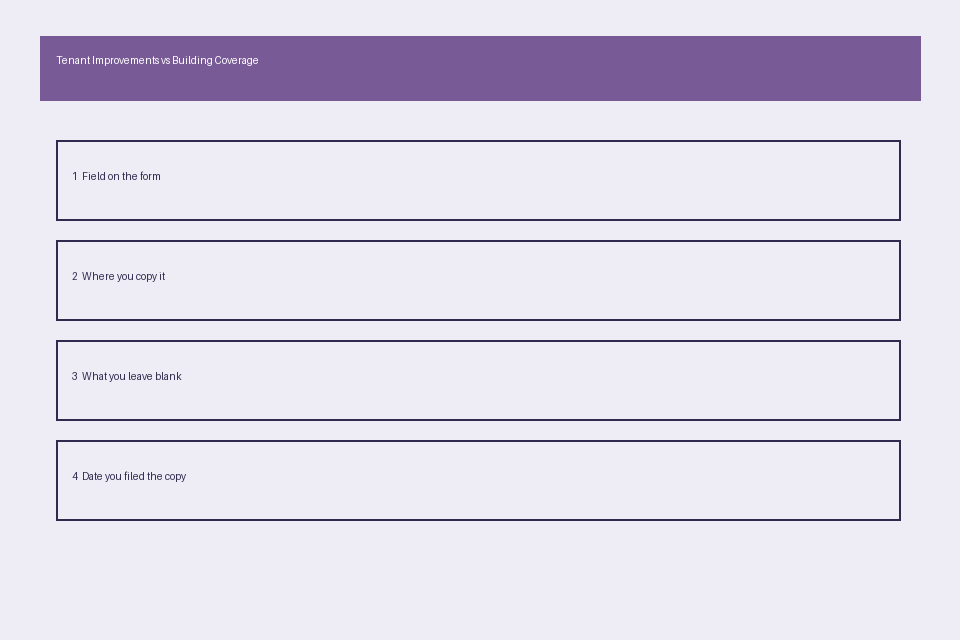
These checkboxes are added to the top of your claim file cover sheet, to allow the carrier’s intake team to quickly route the claim to the correct adjuster pool without manual document review. The standard checkboxes to include are: ☐ Damage originated in a base building structural component (e.g., roof leak, foundation shift, building-wide plumbing failure), ☐ Damage originated in a tenant-installed permanent improvement (e.g., custom tenant plumbing leak, built-in tenant shelving fire, improper TI installation failure), ☐ Damage caused by unapproved tenant modification, ☐ Damage to removable tenant trade fixtures, ☐ Damage from a named peril explicitly excluded from the active TI endorsement. Marking these checkboxes before submission can reduce claim intake processing time significantly, per industry process data, as the adjuster assigned will already have context for the damage source and coverage eligibility constraints before they begin reviewing your file. You should also attach a copy of the damage source verification (e.g., plumber’s report, fire department incident report) next to the checked box to support your classification.
Before filing your next commercial property damage claim, cross-reference the damaged asset against the comparison table above, mark the corresponding damage source checkbox on your claim file cover sheet, and confirm all coverage terms with your licensed insurance broker.