Survey Exception vs a New Survey in the Title File

This survey exception checklist guides consistent, compliant review of title file entries for survey exceptions and new surveys. It is designed for use by in-house file administrators working with mortgage closing folders or commercial property claim files to align documentation with underwriter and carrier requirements, and no legal, title agent, or adjuster advice is provided on this page. All entries should be cross-checked with the issuing title company or assigned claim adjuster before final file submission, and guidance is aligned with standard Margin Desk folder organization frameworks for title document storage.
Survey exception schedule cross-reference procedures
The first step in evaluating survey exception vs new survey eligibility is to locate the title commitment’s Schedule B, Section II, which lists all exceptions to title coverage. Pull the exact verbiage of every exception that references surveys, boundary disputes, encroachments, unrecorded easements, or setback violations, and log each line item in your tracking sheet. Next, cross-reference each exception’s language against the property’s official legal description listed on the recorded deed and the initial title search abstract to confirm there are no discrepancies in lot number, subdivision name, or acreage that would impact exception interpretation. If the exception explicitly states it applies to “matters that would be disclosed by a current, accurate survey,” flag that entry for follow-up to confirm if a new survey was ordered and submitted to the file, or if the exception will be retained as-is in the final title policy. Illustrative example: A title commitment exception reading “Any and all encroachments, overlaps, boundary line disputes, and any other matters that an accurate survey of the property would disclose” requires a cross-reference check against all survey documentation in the file to confirm if the exception can be removed or must remain scheduled. You are not authorized to edit or remove exception language on your own; all proposed changes must be submitted to the issuing title company for written approval. All cross-reference checks should be dated and initialed in the file’s tracking log, with a copy of the marked Schedule B saved to the “Survey Documentation” subfolder of your main title file for audit purposes.
New survey certification box validation requirements
When a new survey is submitted to the title file, you must first validate that all required certification boxes are fully completed and signed by a surveyor licensed to practice in the state where the property is located. Standard required certification boxes include: confirmation that the survey was completed within the underwriter or carrier’s required timeline (typically 3 to 6 months prior to closing or claim filing), confirmation that all visible improvements, recorded and unrecorded easements, encroachments, and setback violations are clearly marked on the survey map, certification that the legal description printed on the survey matches the legal description on the deed and title commitment exactly, and confirmation that the surveyor has provided written notification to the property owner or purchaser of any material boundary defects identified during the survey process. If any box is left blank, unsigned, or marked with a conditional disclaimer, the survey cannot be used to support removal of the standard survey exception, and you must send a formal request to the surveying firm to correct the missing information within 3 business days to avoid delays to closing or claim review. Illustrative example: A new survey submitted with a signed certification that the legal description matches title records, but no mark in the box confirming all encroachments are documented, must be returned to the surveyor for completion before the exception review can proceed. Save a copy of the fully signed certification page as a separate file in the Survey Documentation subfolder, labeled with the surveyor’s state license number and submission date for easy cross-reference during final file audits.
Title file boundary note review workflows
Beyond the formal title schedule and submitted survey, you must review all boundary-related notes stored across the title file to confirm no unaddressed issues impact the survey exception status. First, pull all notes from the title search abstract, escrow communication logs, property inspection reports, seller disclosure forms, and prior claim documentation (for commercial property claim files) that reference boundary lines, fence locations, shared driveways, neighbor boundary disputes, or unrecorded access easements. Cross-reference each note with the submitted survey (if available) and the verbiage of the survey exception on Schedule B to confirm if the issue is addressed in the survey documentation. If a note references a resolved historical boundary dispute with recorded settlement documentation, you can attach that documentation to your exception review submission to support removal of the relevant exception language. If a note references an active, unresolved boundary dispute that is not addressed in the new survey, the standard survey exception must remain in place even if a fully certified survey is submitted, as the dispute is a known defect that falls outside the scope of survey coverage. Log each boundary note in your tracking sheet, note whether it is addressed by the new survey or remains an open exception, and attach a copy of each note to your survey exception tracking document for submission to the title issuer. If a note references an unrecorded easement that is marked on the new survey, confirm with the title issuer if that easement can be added as a separate, specific exception or if it is covered under the existing general survey exception.
Property line adjustment letter review steps
If the title file includes documentation of a property line adjustment between the subject property and an adjacent parcel, you must complete a formal review of the adjustment letter before evaluating survey exception status. First, confirm that the property line adjustment letter is officially recorded with the county recorder’s office; unrecorded adjustment agreements between private parties are not valid for title exception review, as they do not constitute a public change to the property’s legal boundaries. Next, cross-reference the revised legal description in the recorded adjustment letter with the legal description on the new survey and the title commitment to ensure all lot lines, total acreage, and easement locations match exactly across all three documents. Then, confirm that all required parties to the adjustment (adjacent property owners, county planning department representatives, and any lien holders on either parcel) have signed and dated the adjustment letter, and that all required zoning and land use permits for the adjustment have been issued and are included in the title file. If the adjustment is fully executed, recorded, and matches the new survey’s boundary lines, you can include the adjustment letter in your submission to the title issuer to support removal of survey exception language related to historical lot line discrepancies. Illustrative example: A 2022 property line adjustment letter that is recorded with the county, signed by both adjacent property owners, and matches the lot lines marked on a 2024 certified new survey can be used to support removal of a survey exception referencing a 1998 lot line discrepancy. Save a copy of the recorded adjustment letter in both the Survey Documentation subfolder and the Legal Description subfolder of the title file for quick access during final review and audit checks.
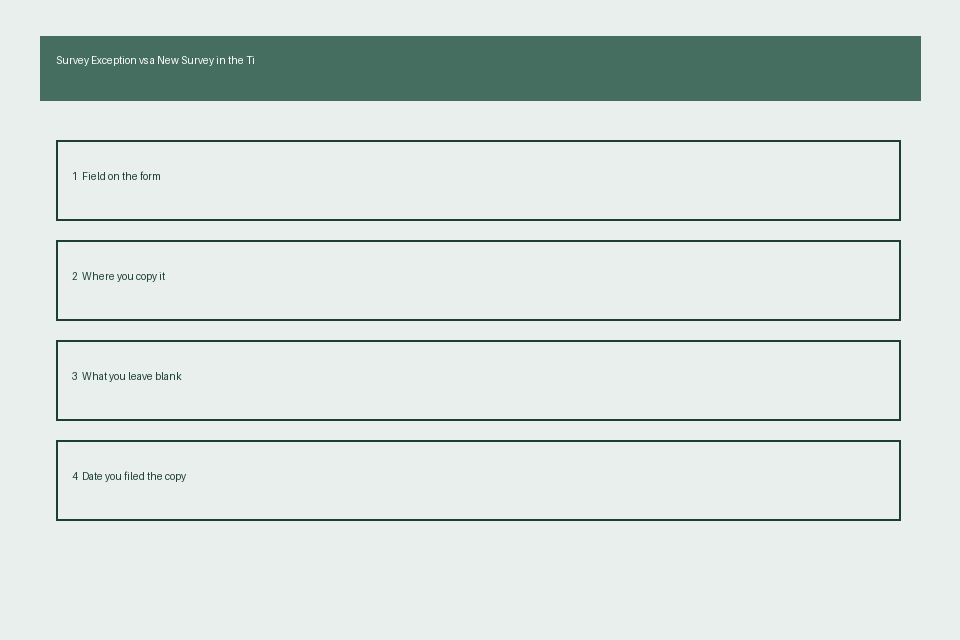
Completed checklist sign-off sheet submission processes
Before submitting your survey exception review to the title issuer or adjuster, you must complete the below survey exception checklist, obtain required sign-offs, and store all documentation in the appropriate file locations.
| Checklist Item | Verification Status (Complete/Incomplete/Needs Follow-Up) | Initials | Date | File Folder Location |
|---|---|---|---|---|
| Title commitment Schedule B survey exception cross-referenced with recorded deed legal description and title search abstract | Survey Documentation > Schedule B Marked Copies | |||
| New survey (if submitted) has all required certification boxes completed and signed by a state-licensed property surveyor | Survey Documentation > Certified Survey Copies | |||
| All boundary-related notes across title file cross-referenced with survey documentation and survey exception language | Survey Documentation > Boundary Note Logs | |||
| Recorded property line adjustment letters (if applicable) matched to new survey boundaries and revised legal description | Survey Documentation > Property Line Adjustment Records | |||
| Survey exception retention or removal recommendation documented with supporting evidence for title issuer review | Final Review Documents > Survey Exception Recommendation | |||
| All supporting survey and exception documentation saved to labeled title file subfolders for audit access | Audit Logs > File Organization Checklists |
Once you have completed all applicable checklist items, mark the verification status for each line, add your initials and date of review, and note the exact file location for each supporting document. Submit the completed checklist to your senior file reviewer for secondary sign-off, who will confirm all entries are accurate and all supporting documentation is present in the file. If any items are marked “Needs Follow-Up,” the reviewer will assign a resolution deadline, typically 5 business days prior to the scheduled closing or commercial property claim submission date, to avoid processing delays. Once all items are marked “Complete” and both the initial reviewer and senior reviewer have signed off on the checklist, save a fully executed copy to the “Final Review Documents” subfolder of the title file, and submit a copy to the issuing title company or assigned claim adjuster for final written approval of the survey exception status. This checklist is for internal file organization purposes only and does not constitute a binding decision on survey exception removal or title coverage; all final decisions are made exclusively by the issuing title provider or carrier.
Before submitting your signed checklist to the title issuer, cross-check the new survey’s completion date one final time to confirm it meets the issuer’s stated timeline requirements for current survey submissions.