Escrow Waiver vs an Escrow Account on the Same Loan

Table entries outline core distinctions between escrow account structures and signed escrow waiver documents for residential mortgage loans. These educational materials are designed to support mortgage closing folder organization, prepared by Margin Desk, and do not constitute lending, tax, or legal advice. You will need to cross-reference all entries against your official loan estimate, closing disclosure, and lender-specific requirements to confirm compliance for your unique loan product. All final decisions related to escrow elections must be confirmed with your licensed loan originator before your scheduled closing date.
Side-by-side table columns listing recurring cost obligations for both election options
| Obligation Category | Escrow Account Election | Escrow Waiver Election |
|---|---|---|
| Property Tax Payments | Lender collects 1/12 of annual estimated property tax with each monthly mortgage payment, disburses full amount directly to the county tax assessor by the statutory due date. | Borrower is solely responsible for saving for and submitting full annual or semi-annual property tax payments directly to the taxing authority, with no oversight or support from the lender. |
| Homeowner’s Insurance Premiums | Lender collects 1/12 of annual insurance premium with each monthly payment, disburses full renewal amount directly to the insurance carrier 30 days before policy expiration to avoid coverage gaps. | Borrower is solely responsible for paying full annual or monthly insurance premiums directly to their carrier, and must provide proof of active, minimum-coverage insurance to the lender annually upon formal request. |
| Private Mortgage Insurance (PMI) / MIP Payments | PMI/MIP amounts are included in the monthly escrow collection, and the lender remits payments directly to the mortgage insurance provider as required by loan terms. | PMI/MIP (if applicable to the loan) is added directly to the monthly principal and interest payment, with no separate tracking obligation for the borrower for these specific payments. |
| Shortfall/Cushion Reserves | Lender may hold a maximum 2-month cushion of projected escrow costs per RESPA guidelines, collected at closing and adjusted during the mandatory annual escrow analysis. | No cushion funds are collected by the lender at closing, and no annual adjustment calculations for escrow-related reserves are applied to the loan’s monthly payment structure. |
| Late Fee Liability for Missed Payments | Lender is liable for all late fees or penalties resulting from their failure to disburse escrowed funds by the required due date, per federal RESPA regulations. | Borrower is 100% liable for all late fees, penalties, tax liens, or lender-placed insurance costs resulting from missed tax or insurance payments, even if the oversight was accidental. |
Signed escrow waiver signature block verification requirements for originating lenders
All originating lenders require that the escrow waiver form is a standalone document, not embedded in the promissory note or deed of trust, to confirm the borrower’s knowing, uncoerced election. You must verify the following elements are present on the signature block for the waiver to be enforceable: 1) Printed full legal names of all borrowers on the loan, matching the names listed on the closing disclosure exactly. 2) Dated signature for each borrower, signed in blue ink unless your lender has pre-approved electronic signatures for your e-closing transaction in writing. 3) A signature line for your licensed loan originator, confirming they disclosed all escrow waiver eligibility criteria, including any applicable loan-level price adjustment, before you made your election. 4) A completed, stamped notary acknowledgement section confirming the identities of all signing borrowers on the execution date. Note that government-backed loan products including FHA, VA, and USDA loans do not permit escrow waivers under any circumstances, so this form will not appear in your closing packet for those products. Retain a fully executed copy of the waiver in your personal mortgage folder to resolve future disputes about your election. If you have questions about the validity of your waiver form, contact your loan originator directly for written confirmation.

Monthly escrow account statement line items for tax and insurance disbursements
If you elect an escrow account, you will receive a monthly statement from your loan servicer that breaks out all escrow-related funds separately from principal and interest charges. The required line items you should confirm are present on every statement include: 1) Previous escrow account balance, carried over from the prior month’s statement, including any interest earned on escrow funds if required by your state’s regulatory guidelines. 2) Total monthly escrow collection amount, broken out by property tax, homeowner’s insurance, PMI/MIP, and any other escrowed costs (such as mandatory flood insurance, if applicable to your property). 3) Any disbursements made from the escrow account during the statement period, including the payee name, payment amount, and payment date for each tax or insurance payment submitted by the servicer. 4) Current escrow account balance after all collections and disbursements are applied for the statement period. 5) Any pending scheduled disbursements for the next 90 days, listed with projected payment amounts and due dates to help you track upcoming expenses. If you have waived escrow, your monthly mortgage statement will only include principal, interest, and any applicable PMI/MIP line items, with no escrow collection or disbursement sections. Retain all monthly escrow statements in your mortgage file for a minimum of 3 years after the loan is paid off, to resolve any future disputes about disbursement timelines or account balances. You can request a copy of any past escrow statement from your loan servicer free of charge per RESPA guidelines, as long as you submit your request in writing within 2 years of the statement date.
Loan closing folder placement guidelines for escrow election documentation packets
When organizing your personal mortgage closing folder, you should group all escrow-related documents in a single dedicated section, separate from promissory note, deed, and title insurance documents, to enable quick access for future reference. If you elected an escrow account, place the following documents in this section, in chronological order: 1) Initial escrow disclosure statement, provided with your loan estimate 3 business days before closing, outlining projected monthly escrow collections and initial cushion amount due at closing. 2) Final escrow disclosure statement, provided with your closing disclosure, confirming the exact escrow amounts collected at closing and first 12 months of projected disbursements. 3) Escrow account agreement, signed by you and your lender at closing, outlining the servicer’s responsibilities for disbursements and annual analysis. If you elected an escrow waiver, place the following documents in this section: 1) Fully executed escrow waiver form, including all required signatures and notary stamp, as outlined in the earlier verification section. 2) Written confirmation from your lender that no escrow funds were collected at closing, and that no escrow charges will be added to your monthly mortgage payment. 3) Copies of the first 12 months of property tax and insurance payment receipts, to demonstrate your ability to make timely payments if your lender requests proof of coverage or payment status. Margin Desk recommends cross-referencing your escrow section documents against your closing disclosure within 30 days of closing to confirm no unauthorized escrow charges were added to your loan without your consent. You should also keep a digital copy of all escrow election documents stored in a password-protected cloud folder, separate from physical copies, to avoid loss in the event of fire, flood, or other property damage.
Annual escrow analysis worksheet adjustment rules for waived vs held accounts
Every year, your loan servicer is required to complete an escrow analysis for all loans with active escrow accounts, to adjust monthly collection amounts based on changes to property tax assessments, insurance premiums, or other escrowed costs. For loans with active escrow accounts, the analysis worksheet will include: 1) A review of the past 12 months of escrow collections and disbursements, to identify any surplus or shortfall in the account. 2) A projection of the next 12 months of escrow disbursements, based on current tax and insurance rates, to calculate the new monthly escrow collection amount. 3) If there is a surplus of more than $50 in the escrow account, the servicer is required to issue a refund check to the borrower within 30 days of completing the analysis. If there is a shortfall, the servicer may spread the repayment of the shortfall over a 12-month period, or require a one-time lump sum payment, at the borrower’s election. For loans with a waived escrow account, no annual escrow analysis is completed by the servicer, and no adjustments to your monthly principal and interest payment will be made for tax or insurance cost changes. You are responsible for adjusting your personal savings plan to account for any increases in property tax or insurance premiums each year, to avoid missed payments or penalties. If your lender determines you have failed to maintain required homeowner’s insurance or pay property taxes on time, they may revoke your escrow waiver and require you to establish an escrow account for the remainder of your loan term, per the terms of your deed of trust. Retain a copy of every annual escrow analysis worksheet in your mortgage file for the full term of your loan, to confirm that all adjustments are consistent with actual tax and insurance costs for your property. If you identify an error on your escrow analysis, you can submit a written dispute to your loan servicer within 60 days of receiving the worksheet, to request a correction and any applicable refund.
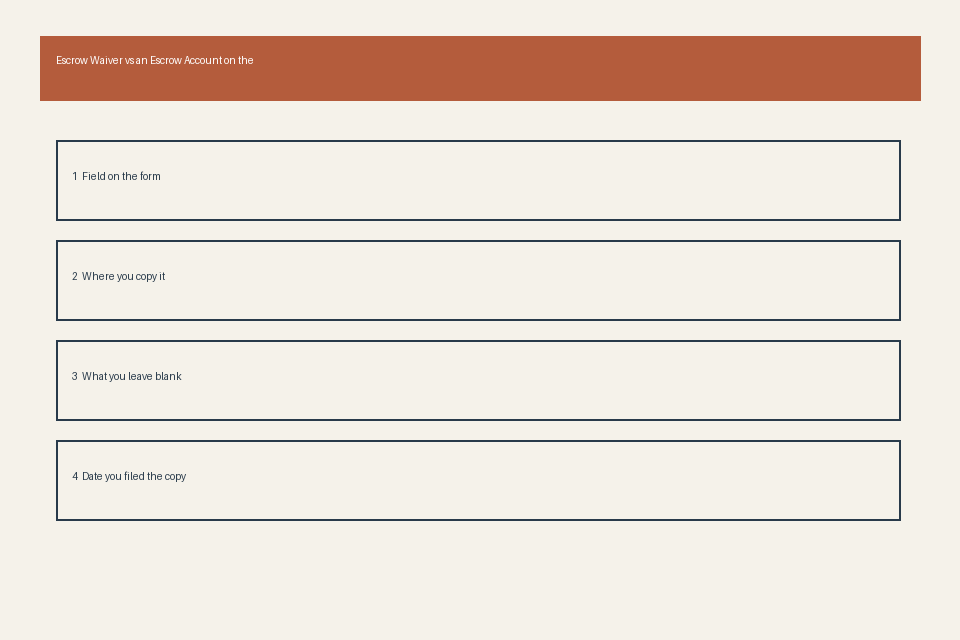
Cross-reference your draft closing packet’s escrow election documents against your signed loan estimate 72 hours before closing to confirm your selected escrow structure matches the terms you agreed to with your originator.