
This printable reference card outlines core differences between peak season endorsements and standard policy base limits for commercial inventory coverage. It is designed to be stored in your commercial property claim file folder alongside policy declarations pages and inventory tracking logs, so you can quickly cross-reference coverage terms when submitting stock loss claims or adjusting coverage for high-volume sales periods. Margin Desk created this reference for general educational use only, and it does not modify existing policy terms or replace guidance from your licensed insurance broker.
Front card column listing peak season endorsement effective date ranges
The front face of the reference card dedicates a full left-hand column to tracking all applicable effective date ranges for peak season endorsements tied to your policy, split into three sub-columns for quick sorting. The first sub-column lists carrier-preapproved peak windows, which are standard high-volume periods aligned with your industry that do not require custom underwriting review to activate. For retail businesses, these windows typically include the 6 weeks leading up to winter holidays, back-to-school season in late summer, and regional tax-free holiday weekends. For agricultural operations, preapproved windows often align with harvest and post-harvest storage periods for primary crops. The second sub-column provides blank space to log custom requested peak windows, which apply to non-standard high-volume periods specific to your business, such as annual trade shows, pop-up sales events, or limited-time product launches that require temporarily elevated inventory coverage. The third sub-column lists carrier-defined excluded blackout dates, during which no new peak season endorsements can be activated, such as periods of active forecasted natural disasters in your service area, or dates falling within 7 days of a declared state of emergency for your county. You should cross-reference these date ranges against your quarterly inventory purchase schedules stored in your claim file before submitting any loss claims, to confirm the loss date falls within an active coverage window before you begin compiling supporting documentation.

Reverse side box noting standard base limit coverage maximum thresholds
The full upper section of the card’s reverse side features a bolded, shaded box reserved for recording your policy’s standard base limit coverage maximum thresholds, which apply to all inventory losses that occur outside of active peak season endorsement windows. Base limits are set at the time you bind your commercial property policy, calculated based on your average monthly on-hand inventory value during non-peak operating months, as documented in your initial policy application materials. Any inventory loss that exceeds this base limit threshold will not be eligible for full reimbursement unless a valid peak season endorsement is marked as active on the date of the loss in your policy declarations. The pre-printed box includes blank fields for you to write your current base limit maximum, your policy renewal date, and the date you last adjusted your base limit with your broker. You should update these fields immediately after every policy renewal or coverage adjustment, and keep a second identical copy of the completed card in your policy declarations folder to cross-reference against the copy in your claim file if there is any discrepancy during claim processing. Note that this reference card does not supersede the official base limit listed in your policy declarations, so you should always confirm values directly with your broker before submitting a formal claim for inventory loss.
Middle fold schedule detailing eligible inventory categories for each coverage tier
The card is scored to fold in thirds, and the middle folded panel features a printed schedule of eligible inventory categories for each coverage tier, so you can quickly confirm if lost or damaged stock qualifies for coverage under either the base limit or an active peak season endorsement. The full schedule is laid out as follows:
| Coverage Tier | Eligible Inventory Categories | Applies To | Required Documentation For Claims |
|---|---|---|---|
| Standard Base Limit | Core operating inventory (regular year-round stock, raw production materials, in-progress finished goods) | All non-peak operating dates, and all dates without an active peak season endorsement on file | Signed monthly inventory count logs, purchase receipts for all goods acquired in the 30 days prior to the loss date, photo or video evidence of damaged stock |
| Pre-Approved Peak Endorsement Tier 1 | Seasonal stock limited to 2x your stated average base limit inventory volume, including limited-run seasonal product lines and holiday-specific stock | Carrier pre-defined peak season windows only, with activation confirmed in writing by your broker | Inventory intake manifests dated within 2 weeks of the start of the pre-approved window, formal point-of-sale projections submitted to your carrier at your last policy renewal, proof of endorsement activation |
| Custom Peak Endorsement Tier 2 | Special order customer stock, pop-up event inventory, limited run promotional goods, and bulk inventory acquired for one-time large sales contracts | Custom requested endorsement windows only, with explicit underwriting approval from your carrier | Signed customer sales contracts or event rental agreements, special order supplier confirmation receipts, written underwriting approval for the custom endorsement window, updated inventory count logs for the duration of the custom window |
| Excluded From All Tiers | Consigned goods not listed on separate scheduled policy addendums, high-value collectibles or art held for resale without separate scheduled coverage, perishable goods held beyond their labeled expiration date, inventory stored in unlisted off-site locations not named on your policy | All operating dates, regardless of active endorsements | No eligible claim submission path for excluded categories; consult your broker to add separate scheduled coverage for any high-value or consigned stock you carry |
You can highlight the categories that apply to your specific business operations directly on the schedule, and attach a copy of any separate scheduled coverage addendums for excluded categories to the back of the card for quick reference during claim intake. This schedule is designed to help you sort eligible and ineligible inventory before you submit a claim, reducing the risk of delayed processing or partial claim denials due to misclassified stock.
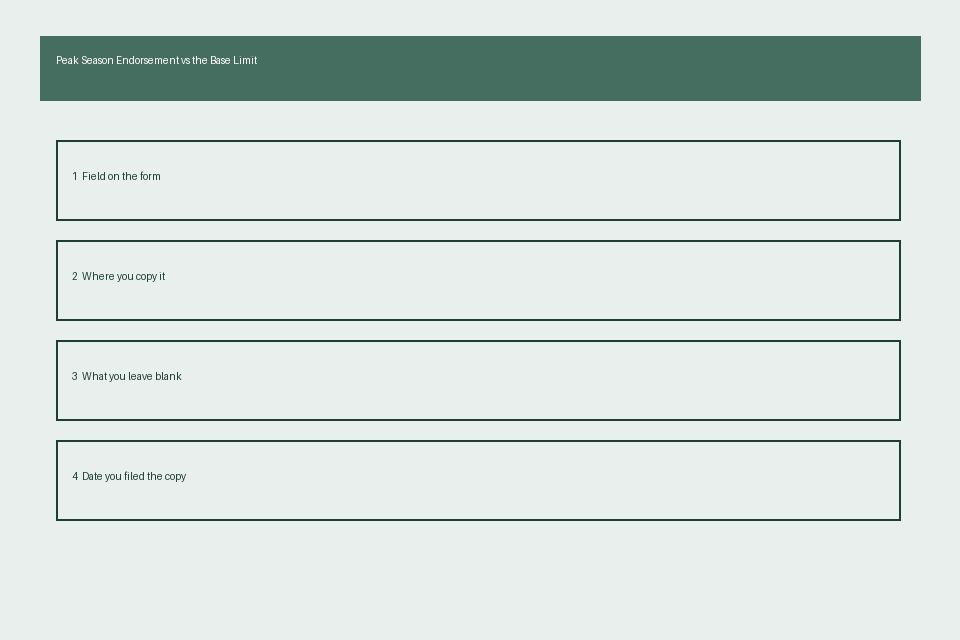
Corner attached coupon for policyholders to request endorsement activation paperwork
The top right corner of the card’s front face features a perforated, detachable coupon you can submit to your licensed insurance broker to request peak season endorsement activation or custom window approval. The coupon includes pre-printed fields for your policy number, your business’s legal name and tax ID, requested effective start and end dates for the endorsement, estimated peak on-hand inventory value during the requested window, and a signature field for your business operations manager or authorized policy contact. Before submitting the coupon to your broker, you should make a full copy of the completed document to file in your commercial property claim folder, so you have proof of the date you submitted the request if there is a processing delay or discrepancy in endorsement activation dates. You can also use the coupon to request adjustments to existing active peak season endorsements, such as increasing your coverage limit if you acquire more inventory than originally projected for the window. Note that submission of the coupon does not guarantee endorsement approval, and you should wait for written confirmation of activation from your broker before purchasing additional inventory that exceeds your base limit.
Back bottom note disclosing required notification timelines for peak season adjustments
The bottom 2 inches of the card’s reverse side features a bolded printed note disclosing your carrier’s required notification timelines for all peak season endorsement requests and adjustments, which are binding for all policyholders. These timelines are set to allow your carrier to complete underwriting reviews for elevated coverage limits before your peak period begins, and requests submitted after the stated timeline will not be approved. For reference, illustrative example: pre-approved peak window endorsement requests require 10 business days advance notification before the window start date, custom peak window requests require 30 business days advance notification to allow for underwriting review of your custom event or sales contract, and adjustments to existing active endorsement limits require 5 business days advance notification before the requested adjustment effective date. You should mark these timeline deadlines on your annual business operations calendar at the start of each year, alongside your scheduled quarterly inventory counts and policy renewal dates, to ensure you submit all endorsement requests with sufficient lead time for approval. If you are uncertain about the specific notification timelines for your policy, you should confirm directly with your broker and write the updated timelines in the blank space provided on the note section of the card.
Print a copy of this reference card, fill in your policy’s current base limit and pre-approved peak dates, and file it in the front of your commercial property claim folder for immediate access during loss intake or coverage adjustment requests.