Tenant Policy vs the Building Owner’s Policy

This structured comparison table outlines key coverage distinctions between tenant and building owner commercial property insurance policies for leased spaces. It is designed to be added to your commercial lease admin folder, alongside your signed lease agreement and proof of coverage documents for both parties. All terms listed are for illustrative reference only; always confirm coverage details directly with your insurance broker or policy issuer before a loss event occurs. Margin Desk provides this educational resource to standardize documentation tracking for leased commercial property files, and this page does not bind coverage or make claim eligibility determinations.
Table column listing tenant policy personal property coverage limits
The first set of columns in the accompanying comparison table explicitly map tenant policy personal property coverage limits, categorized by asset type to simplify cross-referencing with your own policy declarations page. These limits apply exclusively to assets owned by the tenant, including inventory, office furniture, business equipment, temporary fixtures, and tenant-funded improvements and betterments made to the leased space. You may add a custom handwritten column to your printed copy of the table to log your specific policy limits for each asset category, so you do not need to locate your full policy document during the stress of a post-loss event. These limits do not extend to permanent structural elements, even if you paid for minor upgrades that are permanently affixed to the building, unless you have added a specific tenant improvements and betterments rider to your policy. If your lease requires you to carry a minimum amount of personal property coverage, you can highlight that corresponding table cell to make it easy to provide proof of coverage to your building owner upon request.

Table row outlining building owner policy structural damage coverage terms
Each table row dedicated to building owner policy structural damage coverage terms lays out exactly which property elements fall under the owner’s coverage responsibility, so you avoid wasting time filing a claim for damage that is covered under the owner’s policy. These terms align with standard commercial lease language, which typically assigns all structural repair responsibilities to the building owner, unless the damage is proven to be caused by gross negligence on the part of the tenant. Structural elements covered under the owner’s policy include load-bearing walls, roof systems, foundation, common areas, and pre-installed building plumbing, electrical, and ventilation systems that were in place before you occupied the space. If you have made permanent modifications to the space, such as custom built-in shelving or upgraded lighting that you plan to leave behind when your lease ends, confirm with your broker whether those modifications are covered under your tenant policy or the owner’s policy, and add a note to that effect in your lease folder. You may also request a copy of the building owner’s policy declarations page to confirm their coverage limits for structural damage, especially if your business would be severely impacted by long repair timelines following a loss event.
Table cell mapping shared loss deductible obligations for both parties
Individual table cells map out deductible obligations when a loss event impacts both tenant-owned property and building structural elements, eliminating a common point of conflict between tenants and building owners after shared events such as fires, storm damage, or pipe bursts. These cells outline the standard default deductible split, but you should always cross-reference with your signed lease, as some leases require tenants to cover a portion of the building owner’s deductible if the loss is caused by the tenant’s actions. Illustrative example: If a tenant accidentally causes a fire in a leased retail space that results in $12,000 in damage to the tenant’s inventory and $28,000 in damage to the building’s walls and electrical system, the tenant would pay their personal property deductible for the inventory damage, and if the lease specifies the tenant is liable for damage caused by their negligence, they may also be required to cover the building owner’s deductible for the structural damage. Log any custom deductible split terms from your lease in the notes column of the table, so you have a single reference point for deductible obligations if a loss occurs.
Table footer noting excluded events not covered by either policy type
The table footer lists common events that are excluded from both standard tenant and building owner commercial property policies, so you can quickly identify gaps in coverage that could leave you financially liable after a loss event. Standard exclusions listed include flood, earthquake, sinkhole damage, acts of war, intentional damage caused by the policy holder, normal wear and tear, and damage caused by unaddressed code violations that the policy holder was aware of but did not repair. If your business is located in a FEMA-designated flood zone, you will need to purchase a separate flood insurance policy, as standard commercial property policies do not cover flood damage, and you can add a note of your flood policy number to the footer of your printed table for easy reference. Some policies may also exclude coverage for loss events that occur if you failed to maintain required safety equipment, such as fire extinguishers or smoke alarms, so you should also log your safety equipment inspection dates in your lease folder to avoid potential claim denials.
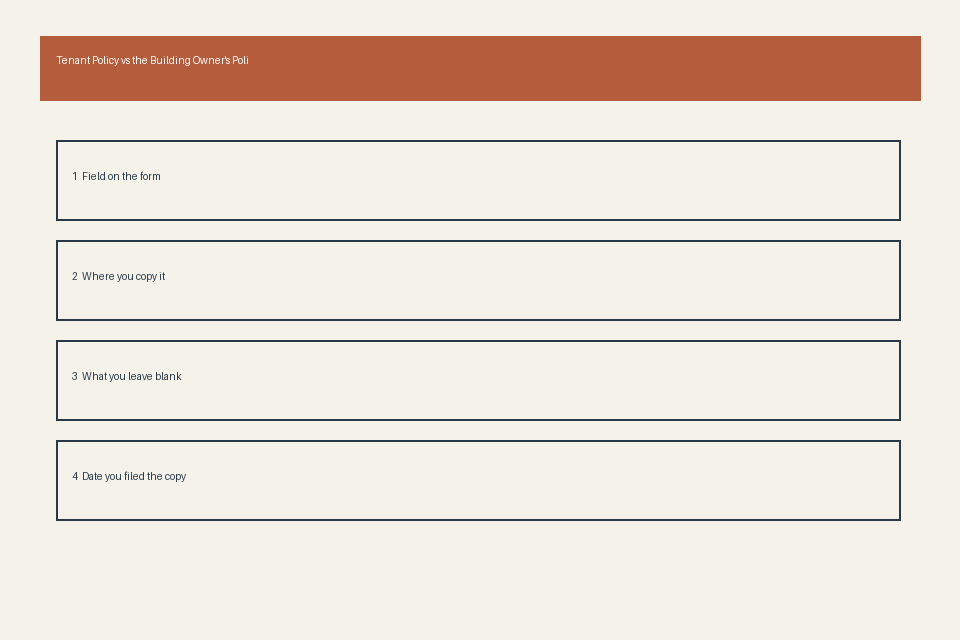
Table schedule specifying claim filing deadlines for each policy holder
The table schedule outlines standard claim filing deadlines for both tenants and building owners, which are set by state insurance regulators and individual policy carriers, and missing these deadlines can result in a full denial of your claim even if the damage is covered under your policy. The standard deadline for most commercial property claims is between 3 and 10 business days from the date you discovered the loss, but some carriers may have shorter deadlines for catastrophic loss events such as major storms or wildfires. Add a reminder to your business calendar and your lease folder’s calendar tab with your specific policy’s filing deadline, so you do not miss the window if a loss occurs. The building owner is also required to notify all affected tenants of their structural claim filing within a set timeline, usually 15 business days from the date of loss, and you can follow up with the building owner if you do not receive notification within that window to ensure the claim is filed correctly.
| Coverage Category | Tenant (Renter) Commercial Policy | Building Owner Commercial Policy | Shared Obligation Notes |
|---|---|---|---|
| Personal Property Coverage Limits | Covers tenant-owned inventory, furniture, equipment, temporary fixtures, tenant improvements and betterments, and tenant business interruption costs | Does not cover any tenant-owned assets; only covers owner-owned permanent building fixtures and structural elements | Tenant must provide proof of meeting lease-required minimum limits to building owner prior to move-in, and update proof of coverage annually upon policy renewal |
| Structural Damage Coverage | Does not cover permanent structural elements including walls, roof, foundation, common areas, or pre-installed building plumbing/electrical systems | Covers all permanent structural elements, common area repairs, and pre-installed building systems damaged by covered perils | Building owner is responsible for filing structural damage claims within their policy’s filing window, and must notify all affected tenants of claim status updates every 30 days during the repair process |
| Shared Loss Deductible Obligations | Tenant pays their policy’s deductible for all tenant-owned property damage claims, regardless of root cause of loss, unless the lease explicitly specifies the owner is liable for the loss event | Building owner pays their policy’s deductible for all structural damage claims, unless the loss event is proven to be caused by tenant negligence per signed lease terms | If both parties file claims for the same loss event, each party is responsible for their own deductible unless a legal agreement or lease clause specifies an alternate split of costs |
| Excluded Events | Standard exclusions include flood, earthquake, intentional damage, normal wear and tear, and damage caused by unreported code violations the tenant was notified to address | Standard exclusions match tenant policy exclusions for flood, earthquake, intentional damage, and normal wear and tear, plus exclusions for tenant-owned property damage and tenant business interruption costs | Separate policy riders are required for all excluded events, and both parties must provide proof of optional riders to each other if required by the signed lease agreement |
| Claim Filing Deadlines | Standard deadline of 3 to 10 business days from the date of loss to file a claim with your carrier, per most state insurance regulatory rules | Standard deadline of 3 to 10 business days from the date of loss to file a structural damage claim, plus 15 business days to provide written notification to all affected tenants of the claim filing | Both parties must share copies of all claim filing documentation with each other within 5 business days of submission to align on repair timelines and avoid conflicting claim submissions |
Print a copy of this table, fill in your specific policy limits, deductible amounts, and filing deadlines from your own policy declarations page and signed lease, and store it in your commercial lease admin folder next to your proof of coverage documents for quick access during a loss event.