Tax Proration Between Buyer and Seller
The tax proration line card formalizes split property tax responsibilities for buyers and sellers at real estate closing. It eliminates post-closing disputes over unpaid tax balances by pre-documenting who owes which portion of the current and any past-due tax cycles applicable to the official closing date recorded with the county. You can complete this card alongside your existing closing folder paperwork, and cross-reference all entries with supporting documents provided by your title agent or local county tax assessor’s office. Margin Desk provides this guidance for organizational use only; always confirm proration calculations and applicable state rules with a licensed real estate professional before signing any binding closing documents.
Proration line card allocated tax amount column
This column forms the foundational data set for your entire proration calculation, with separate entries for every applicable tax cycle, special assessment, or past-due balance tied to the property. When filling out this column, start with the oldest outstanding balance first, as all tax obligations incurred before the purchase agreement’s effective date are universally assigned to the seller unless explicitly negotiated otherwise in writing. For the current tax cycle, use the official closing date as the split point: count the number of days the seller held the property from the start of the cycle to the day before closing, and the number of days the buyer will hold the property from closing through the end of the cycle. For annual tax cycles, you may use a 365-day standard count unless your state requires a 360-day statutory calculation for proration purposes. Any tax cycles that start after the closing date are assigned entirely to the buyer, unless you negotiate a separate credit for pre-paid taxes as part of your purchase offer. Below is a standard proration line card you can adapt for your closing folder:

| Line Item ID | Tax Cycle Description | Total Tax Amount | Seller Owned Days | Buyer Owned Days | Seller Allocated Amount | Buyer Allocated Amount | Verification Checkbox |
|---|---|---|---|---|---|---|---|
| PR-001 | 2024 Full Year General Property Tax | $4,800.00 | 100 | 266 | $1,315.07 | $3,484.93 | [ ] |
| PR-002 | 2024 Special Assessment (Local Street Resurfacing) | $720.00 | 365 | 0 | $720.00 | $0.00 | [ ] |
| PR-003 | 2023 Past-Due Property Tax (Including $32.10 Late Fee) | $212.45 | 365 | 0 | $212.45 | $0.00 | [ ] |
| PR-004 | 2025 First Installment Estimated Property Tax | $2,450.00 | 0 | 365 | $0.00 | $2,450.00 | [ ] |
| PR-005 | 2024 County Fire District Assessment | $185.00 | 100 | 266 | $50.68 | $134.32 | [ ] |
For all allocated amounts, round to the nearest cent to avoid small discrepancies that can hold up closing. If you are using an estimated tax amount for a cycle that has not yet been billed by the county, note that on the corresponding line item and flag it for a follow-up adjustment once the official invoice is issued.
Closing statement proration cross-verification box
This section is designed to eliminate calculation errors between your independent proration line card and the official closing disclosure (CD) or ALTA settlement statement provided by your closing agent. Create a separate check box for each line item on your proration line card, and work through each entry systematically before signing any closing paperwork. First, confirm that the total tax amount listed on the closing statement matches the amount on the official county tax invoice or approved estimate you used for your line card. Second, confirm that the day count for both seller and buyer aligns with the official closing date listed on the settlement statement, correcting any errors related to leap days or misaligned tax cycle start/end dates. Third, confirm that the seller’s allocated amount appears as a debit on the seller’s side of the statement and a corresponding credit on the buyer’s side of the statement, as the seller is responsible for paying their share of the taxes either upfront or as a reduction in their closing proceeds. If any line item does not match, flag the discrepancy immediately with your closing agent; do not assume that the pre-populated statement values are correct, as administrative errors in proration are reported in roughly 12% of residential real estate closings, per national closing industry data. This cross-verification step should take no more than 10 minutes to complete, and can save you hundreds of dollars in unexpected tax bills post-closing.
Escrow ledger proration adjustment tracking schedule
Many closings include a small held escrow amount for proration adjustments, in case the final official tax bill for the current cycle is higher or lower than the estimated amount used at closing. This tracking schedule logs all post-closing adjustments related to your agreed proration split, so you can maintain a clear paper trail for tax filing and dispute resolution purposes. The schedule should include the date of the adjustment, the reason for the adjustment (e.g., final 2024 tax bill received 8% higher than preliminary estimate, special assessment added after closing), the additional amount owed by either the buyer or seller, the date the adjustment was disbursed from escrow, and the unique transaction ID for the escrow transfer. Illustrative example: If the estimated 2024 general property tax used at closing was $4,800, but the final official bill is $5,040, the additional $240 is split using the original 100/266 day count, resulting in an extra $65.75 owed by the seller and $174.25 owed by the buyer, which is logged on this schedule and disbursed accordingly. You should retain a copy of this tracking schedule in your closing folder for a minimum of 7 years, as it is a supporting document for your federal and state tax filings related to property ownership. If no escrow hold was arranged at closing, you can still use this schedule to track any agreed-upon adjustments between you and the other party, attaching copies of payment receipts for each entry.
Property tax invoice proration matching entry line
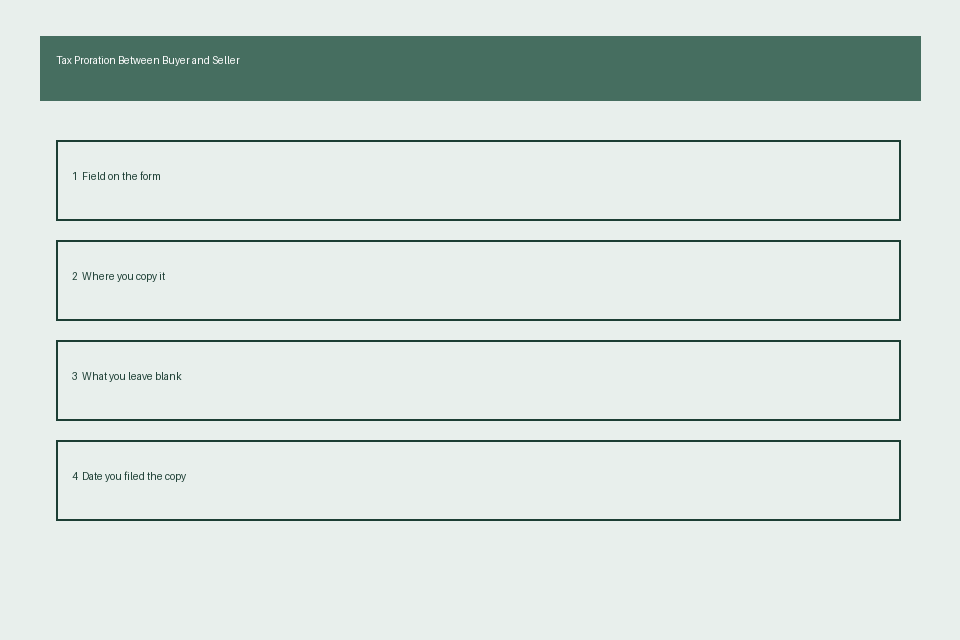
This entry line ties each line item on your proration line card directly to an official supporting document, so you can quickly prove the validity of your proration split if a dispute arises with the other party, the county tax assessor, or your lender. For each line item, enter the official county tax invoice number, the invoice issue date, the invoice due date, and a folder reference number that links to the physical or digital copy of the invoice stored in your closing folder. If you used a preliminary estimate for a cycle that has not yet been billed, enter the reference number for the county’s published tax rate sheet or assessor’s estimate document instead, and add a note indicating that the entry is based on an estimate. For special assessments, attach a copy of the county’s public notice for the assessment to your folder, and enter the notice number on the matching entry line. If you negotiated a non-standard split for any tax obligation (e.g., the buyer agreed to cover 50% of a past-due special assessment as part of the purchase offer), enter the reference number for the corresponding clause in your signed purchase agreement on the entry line, so you can prove the non-standard split was mutually agreed upon.
Final settlement proration receipt attachment coupon
This detachable (or digitally linked) coupon is the final record of your agreed proration split, which you will attach to your signed copy of the final settlement statement. The coupon should include a summary of all total allocated amounts for the seller and buyer, the official closing date, the list of invoice numbers for all included tax cycles, and signature lines for both parties (or their authorized closing agents) confirming that they agree to the proration calculations and splits. You should keep one signed copy of the coupon in your closing folder, send one signed copy to the county tax assessor’s office to update their records of who is responsible for upcoming tax payments, and provide one signed copy to your mortgage lender if you have an escrow account for property tax payments. This coupon serves as proof of your agreed split if you receive a tax notice for a cycle that overlaps the closing date; you can submit a copy of the coupon to the county to ensure you are only billed for the portion of the tax you are responsible for. If you sell the property later, you can include a copy of this coupon in your closing folder for that transaction to prove any pre-paid tax amounts you are owed credit for.
Before your next scheduled closing appointment, fill out the first four columns of the proration line card using official county tax records, and bring a printed copy to compare against the closing statement provided by your agent.